A vehicle’s suspension system is often described as the component responsible for a plush, comfortable ride. While isolating passengers from potholes, washboard gravel, and expansion joints is certainly part of the job, comfort is actually a secondary byproduct of its true engineering purpose. The primary objective of any automotive suspension is maintaining continuous, stable contact between four small patches of tire rubber and the road surface beneath them.
When a suspension system operates correctly, braking distances remain short, steering inputs translate instantly into directional changes, and the chassis stays level during high-speed emergency maneuvers. Because suspension components wear down gradually over tens of thousands of miles, many drivers unconsciously adapt to the worsening degradation. They subconsciously adjust to longer stopping distances, compensate for drifting steering wheels, and brace for harsh vibrations, assuming their car is merely aging.
Waiting for an outright mechanical failure before visiting a repair facility is a dangerous gamble. A compromised suspension turns routine panic stops into uncontrolled slides and accelerates wear across tires, brakes, and steering linkages. Recognizing the physical warning signs of suspension failure allows motorists to intervene before a worn bushing or leaky damper turns into an expensive, hazardous roadside breakdown.
Worn Struts and Shock Absorbers: The Loss of Damping Control
Shock absorbers and MacPherson struts do not actually support the physical weight of a vehicle; that task belongs to the springs. Instead, shocks and struts act as hydraulic dampeners. When a tire hits a bump, the spring compresses and immediately wants to bounce repeatedly like a child on a pogo stick. The shock absorber uses internal hydraulic fluid forced through precision valving to absorb that kinetic energy, halting the oscillation after a single bounce.
Over years of continuous friction and road impacts, internal seals fail and hydraulic fluid slowly weeps out along the damper shaft. Once fluid levels drop or internal piston valves erode, the unit loses its ability to control spring motion.
Common symptoms of worn shocks and struts include:
-
Severe Nose-Diving Under Braking: When the front dampers can no longer control forward weight transfer, applying firm brake pressure causes the front bumper to drop aggressively toward the asphalt, transferring weight off the rear tires and dramatically lengthening stopping distances.
-
Excessive Body Roll and Squatting: Turning through highway cloverleaf ramps causes the vehicle to lean heavily outward, while hard acceleration causes the rear end to sink toward the road.
-
Scalloped or Cupped Tire Wear: Without adequate damping, the tire literally bounces down the highway at high speeds, creating distinct high and low scalloped divots across the tread surface.
Replacing struts is not a simple driveway chore. MacPherson strut assemblies store tremendous amounts of potential energy under heavy mechanical spring tension. Disassembling a strut without commercial wall-mounted spring compressors poses a severe risk of physical injury, making this a repair best left to certified technicians equipped with industrial hydraulic tools.
Broken or Sagging Springs: Structural Collapse Beneath the Frame
Springs—whether traditional steel coils, heavy-duty leaf packs, or modern air bladders—dictate the vehicle’s resting ride height and support its total curb weight.
While coil springs are designed to endure millions of compression cycles, environmental exposure and metal fatigue eventually take their toll. In northern climates where road salt and chemical de-icers are applied heavily during winter, moisture becomes trapped inside the protective plastic coatings of coil springs. Rust pits form beneath the surface, creating stress concentrations that cause the hardened steel to fracture cleanly under load.
A broken or sagging spring alters the entire geometry of the vehicle. You may notice one corner of the car sitting visibly lower than the others when parked on a level surface. Driving over bumps produces a harsh, metallic clunk as the compromised suspension bottoms out against its rubber bump stops.
Operating a vehicle with a broken spring creates extreme camber and toe misalignments, scrubbing expensive tire tread down to the cord in a matter of hundreds of miles. More critically, a snapped spring coil can shift out of its perch and puncture a tire sidewall or sever a hydraulic brake line at highway speeds.
Failing Ball Joints: The Critical Steering Pivot Point
Ball joints function as the human hip of the automotive world. They are precision ball-and-socket assemblies that connect the moving suspension control arms to the rigid steering knuckles, allowing the front wheels to turn left and right while simultaneously traveling up and down over road imperfections.
Ball joints are packed with high-pressure grease and sealed inside flexible rubber or polyurethane boots. Over time, road debris, engine oil leaks, and heat cycles dry-rot the rubber boot, allowing the protective lubricant to escape while inviting abrasive road grit inside. Metal begins grinding directly against metal.
Early warning signs of ball joint failure include:
-
Creaking, Squeaking, or Snapping Sounds: High-pitched creaks when traveling over driveways or clicking sounds when turning the steering wheel at low speeds in parking lots.
-
Vague or Wandering Steering: The front wheels develop microscopic play, requiring constant micro-corrections on the highway to keep the vehicle tracking in a straight line.
-
Uneven Inner-Edge Tire Wear: As the ball joint loosens inside its steel housing, the wheel tilts inward, concentrating the car’s weight on the inside shoulder of the tire.
Ball joint failure is exceptionally dangerous because it rarely gives a second warning once the socket wears past its limit. If a ball joint separates while driving, the control arm drops instantly to the pavement, folding the wheel outward into the fender and causing a complete loss of steering control.
Deteriorated Control Arm Bushings: Silent Misalignment
Control arms connect the wheel assembly to the vehicle’s subframe. To prevent road vibrations from rattling directly into the passenger cabin, control arms pivot on heavy-duty rubber-to-metal or polyurethane elastomer bushings.
These bushings are subject to constant torsional stress, heat from the braking system, and fluid contamination. Over time, the rubber dry-rots, cracks, and tears away from its metal inner sleeve.
When a bushing tears completely, the control arm begins shifting horizontally during acceleration and braking. Drivers typically hear a dull, heavy thump from beneath the floorboards whenever they step firmly on the brake pedal or accelerate away from a stoplight. Because worn bushings introduce uncontrolled play into the suspension arm, the vehicle cannot hold a wheel alignment; you can pay for an alignment service, but the moment you hit a pothole, the alignment angles shift out of specification again.
Pressing old, seized bushings out of steel or aluminum control arms requires twenty-ton hydraulic shop presses and specific adapter sleeves. Professional repair facilities typically replace the entire control arm assembly to guarantee factory-spec integrity and restore structural rigidity.
Worn Sway Bar Links and Anti-Roll Bushings
The sway bar—also known as an anti-roll bar—is a torsional steel rod that spans across the front and rear axles. Its role is simple: when your car leans into a turn, the bar twists, forcing the opposite wheel down to keep the chassis flat and stable.
The sway bar attaches to the suspension through slender vertical components known as sway bar end links, which utilize miniature ball joints or stacked rubber grommets at each end. Because these links absorb continuous lateral forces, they are frequently the very first suspension components to wear out on modern vehicles.
When sway bar links loosen, they emit a rhythmic, hollow rattling or knocking sound whenever you drive over minor road irregularities, such as washboard dirt roads or utility cuts in asphalt. While a broken sway bar link will rarely cause a catastrophic wheel collapse, it dramatically increases body sway during fast maneuvers, making the vehicle feel skittish, unsettled, and prone to losing grip during sudden obstacle avoidance.
The Cost of Postponing Suspension Maintenance
Treating suspension noises as minor annoyances is one of the most common false economies in vehicle ownership. Automotive chassis components do not operate in isolation; they function as a unified kinetic chain.
When a shock absorber fails, the spring is forced to take on uncontrolled oscillations, rapidly fatiguing the steel. The excess movement slams into the ball joints, which in turn degrades the control arm bushings and rattles the steering rack. A deferred two-hundred-dollar repair on a single pair of sway bar links can quietly degrade hundreds of dollars worth of adjacent bushings and destroy thousands of dollars in performance tires.
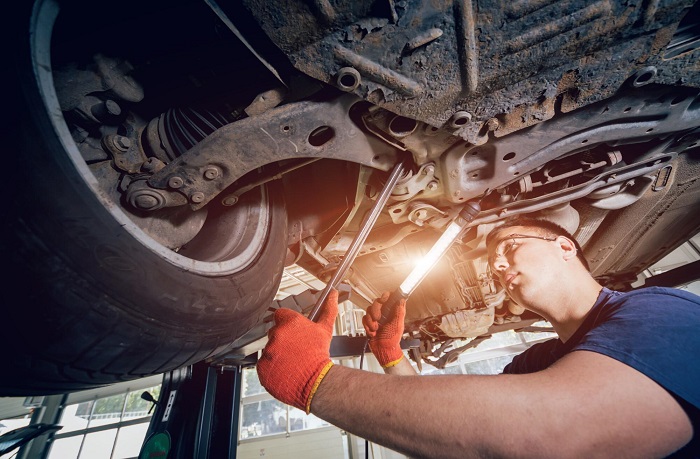
Modern suspension diagnosis requires specialized tools, including drive-on chassis ear listening devices, hydraulic lift plates, and computer-guided laser alignment racks. If your vehicle exhibits steering wander, unusual rattles over bumps, or uneven tire wear, schedule an evaluation with an experienced automotive technician. Restoring your suspension does more than silence annoying squeaks; it preserves the mechanical integrity of your vehicle and ensures that when an emergency stop occurs, your car responds with predictable, life-saving precision.